
A resident Indian can buy foreign currency notes and coins worth up to USD 3,000 per visit for most countries, as of November 2026. The rest of the travel budget goes on a prepaid forex card, traveller's cheques or a banker's draft. You can also take up to ₹25,000 in Indian notes.
So the answer to "how much forex can I carry from India" has three parts: a cash limit per visit, a yearly ceiling on all your travel foreign exchange, and customs rules when you come home. This guide takes each limit from the Reserve Bank of India (RBI) and customs rules, checked on 24 November 2026, and turns them into a plan for your trip from Chennai.
Foreign currency cash limit for travel from India: the rules at a glance
| What | Limit or rule (as of November 2026) |
|---|---|
| Foreign currency notes and coins, most countries | Up to USD 3,000 or equivalent per visit |
| Iraq and Libya | Up to USD 5,000 or equivalent per visit |
| Iran, Russia and other CIS republics | Full entitlement may be taken as notes and coins |
| Haj and Umrah | Full entitlement in cash, or up to the Haj Committee of India's cash limit |
| Amount above the cash limit | Prepaid forex card, traveller's cheques or banker's draft |
| All travel foreign exchange in a year | Within the LRS limit of USD 250,000 per financial year |
| Paying in rupee cash for forex | Only for purchases below ₹50,000 |
| Indian rupee notes, out and back | Up to ₹25,000 per person |
| Declaration on arrival in India | If notes exceed USD 5,000, or notes, bank notes and traveller's cheques together exceed USD 10,000 |
| Leftover notes and traveller's cheques | Sell within 180 days of return, or keep up to USD 2,000 |
| Foreign coins | No limit on holding |
How much forex can I carry from India in cash per trip?
For most countries, you can buy and carry foreign currency notes and coins worth up to USD 3,000 or its equivalent per visit. The figure comes from the RBI FAQ on miscellaneous forex facilities, updated on 28 November 2025, and the RBI Master Direction on remittance facilities, updated on 1 October 2026. Where an FAQ and a Master Direction differ, the Master Direction prevails.
That is the short answer to how much cash you can carry abroad from India, whether the trip is a holiday, a business visit or a study trip. The limit applies to each visit, and every trip also counts towards your yearly LRS limit, explained below.
The limit is set in US dollars but covers every currency. A Singapore trip means up to USD 3,000 worth of Singapore dollars, and a Dubai trip up to USD 3,000 worth of dirhams. Rates move during the day, so check today's buy and sell rates or the US dollar rate in Chennai today when you work out the rupee amount.
Do the limits differ for some countries, or for Haj and Umrah?
Yes. The RBI sets different cash limits for a few destinations. Travellers to Iraq or Libya can take up to USD 5,000 or its equivalent per visit in notes and coins. Travellers to Iran, Russia and the other Commonwealth of Independent States republics can take their full foreign exchange entitlement, up to USD 250,000, in notes and coins.
Pilgrims going for Haj or Umrah can receive their full entitlement in cash, or up to the cash limit set by the Haj Committee of India. Both banks and full-fledged money changers can release this foreign exchange.
Nepal and Bhutan follow separate rules. Foreign exchange is not released for travel to these two countries, and the rules for Indian rupee notes are explained below.
How do I carry the rest of my travel budget?
Anything above the cash limit can be carried on a prepaid forex card, as traveller's cheques or as a banker's draft. All of it sits inside the Liberalised Remittance Scheme (LRS), which allows a resident up to USD 250,000 per financial year, from April to March, however many trips you take. This LRS limit for foreign travel also covers overseas hotel and tour costs, forex card spends and international debit card spends.
A simple way to plan is to split your budget by how you will spend it:
- Work out your total trip budget in the destination currency.
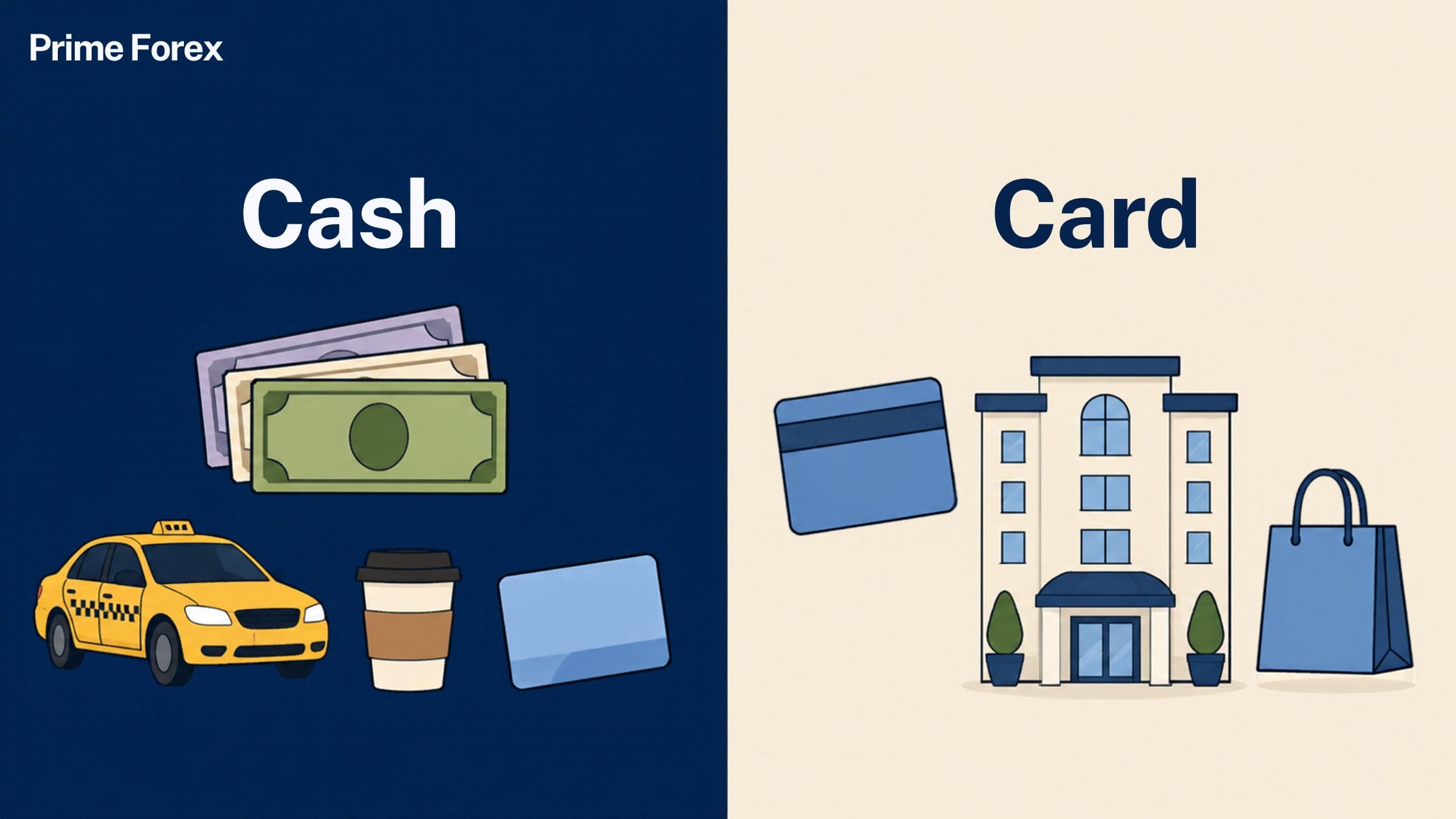
- Keep cash for small daily spends such as taxis, tips, food stalls and transport cards, within the cash limit.
- Put hotel bills, shopping and larger spends on a forex card.
- Keep a card from your bank as a backup.
For example, a traveller going to Singapore with a budget worth USD 4,500 could take up to USD 3,000 worth of Singapore dollars in cash and load the remaining USD 1,500 worth on a forex card. You do not have to take the full cash limit, so take only what your daily spends need.
You can buy foreign currency in Chennai at a Prime Forex branch, at its counters on the Chennai Airport campus or through same-day home delivery. Prime Forex can also help you with a forex travel card for the rest of your budget.
Can I pay cash to buy forex, and is TCS charged?
You can pay in rupee cash only when the forex you buy is worth less than ₹50,000. For ₹50,000 and above, the RBI requires the entire payment by crossed cheque, banker's cheque, pay order, demand draft, debit card, credit card or prepaid card. Part payment in cash is not allowed for a purchase of this size.
Tax collected at source (TCS) may apply when you buy forex for travel, and the counter will show it on your bill, so check the Income Tax Department website for the current rules.
How much Indian rupees can I carry abroad and bring back?
A resident can take up to ₹25,000 in Indian currency notes when travelling abroad, and bring back up to ₹25,000 on return. This comes from the Foreign Exchange Management (Export and Import of Currency) Regulations, as amended up to 24 February 2026. The limit is per person and sits apart from your foreign currency limit.
Nepal and Bhutan have their own rule, in force from 2 December 2025. When travelling between India and Nepal or Bhutan, you can carry Indian notes of up to ₹100 freely, but notes above ₹100 only up to a total of ₹25,000.
Do I need a currency declaration form in India?
You need one only when you arrive in India with more than the set amount. Declare your foreign exchange to customs on the Currency Declaration Form (CDF) if your foreign currency notes exceed USD 5,000, or if your notes, bank notes and traveller's cheques together exceed USD 10,000. Below both figures, no currency declaration is needed.
The Customs Baggage (Declaration and Processing) Regulations, in force since 2 February 2026, ask passengers carrying dutiable goods to declare them electronically, including through the Atithi app. Currency is declared separately on the CDF, as the FEMA regulations require.
When you leave India, the FEMA regulations allow you to take out foreign exchange you bought from an authorised person, such as a bank or a full-fledged money changer. Keep the purchase receipt with your travel papers. Your destination country may have its own declaration limit, so check its customs website before you fly.
What should I do with leftover foreign currency after return to India?
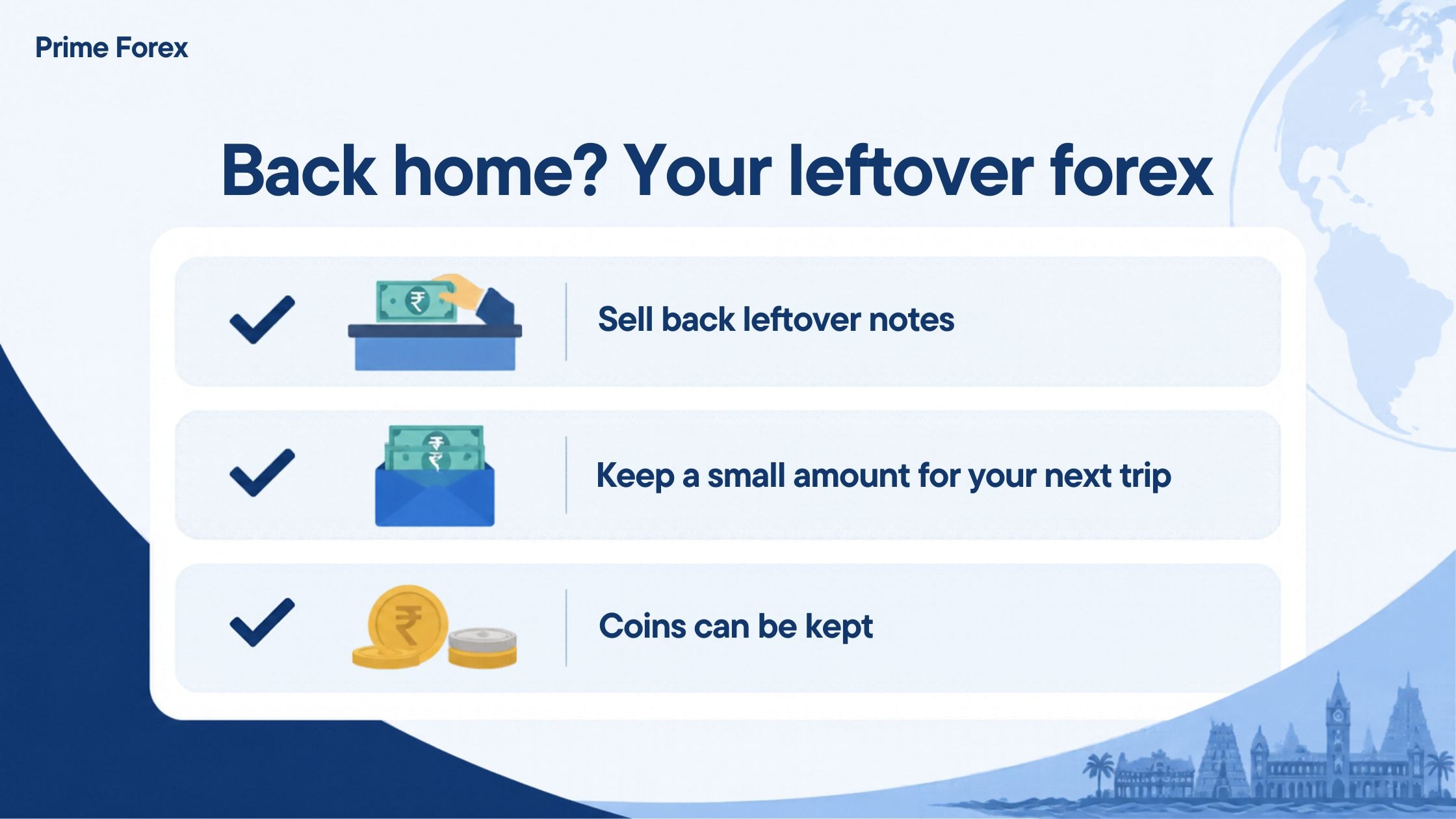
Sell unspent foreign currency notes and traveller's cheques to an authorised person within 180 days of your return. You may keep up to USD 2,000 in notes and traveller's cheques for a future trip, or credit it to a Resident Foreign Currency (Domestic) account. Foreign coins can be kept without any limit. These rules are set out in the RBI Master Direction on Other Remittance Facilities.
An unused forex card balance can also be redeemed on request.
Landing in Chennai, you can sell leftover foreign currency at the Prime Forex counters on the airport campus or at any branch.
Before you fly from Chennai: a quick checklist
- Check whether your destination has a special cash limit.
- Decide how much of your budget you need as cash, within USD 3,000 or equivalent per visit.
- Plan the rest on a forex card or other cards, within your LRS limit.
- Pay by cheque, draft or card if your forex purchase is ₹50,000 or more.
- Carry no more than ₹25,000 in Indian notes.
- Keep your forex purchase receipt with your passport.
- Check your destination's customs rules for cash.
Last-minute travellers can use the forex counter at Chennai Airport Metro, or find a Prime Forex branch near you across the city.
Limits and rules change, so confirm with a Prime Forex branch before you travel.